SQL Server DBA + SQL Programming + Azure SQL Training (Online)
By Daniel AG, #1 Database Trainer in USA!!! (*****)
Course Description
Our Microsoft SQL Server DBA and SQL Programming course (both on-prem and Azure Cloud) is designed to provide a complete learning pathway for anyone seeking to master SQL Server in today’s hybrid data landscape. Whether you are an aspiring database professional starting fresh or an experienced IT specialist looking to upgrade your skills, this course offers the knowledge and hands-on expertise you need. No prior experience is required, making it accessible to beginners, while the depth of topics ensures value for seasoned professionals.
The program begins with a solid foundation in database concepts and SQL programming using Transact-SQL (T-SQL). From there, you will gain practical knowledge in installing and configuring SQL Server, managing day-to-day database administration tasks, and implementing high availability and disaster recovery strategies to ensure business continuity. The course also emphasizes performance monitoring and tuning, equipping you with the skills to maintain stable, secure, and efficient database systems.
As cloud adoption continues to reshape IT, we include a dedicated module on Azure SQL, where you will learn administration techniques unique to Microsoft’s cloud platform. You will also gain hands-on experience with database migration strategies, enabling you to confidently move workloads from on-premises SQL Servers to Azure SQL while maintaining performance and data integrity.
To enhance the quality of learning, every participant receives official Microsoft courseware, including Querying Data with Transact-SQL and Administering Microsoft SQL Server Databases. These materials align with Microsoft’s certification tracks and can serve as valuable references even after the training is completed.
With over a decade of experience training thousands of students across the USA, Canada, and beyond, we are proud to offer high-quality, affordable programs in SQL Server, Azure, AWS, AI, and related technologies. Based in Philadelphia, USA, our training combines structured teaching, real-world case studies, and practical labs to prepare you for real-life database management scenarios in both corporate and cloud environments.
For complete course details, schedules, and registration, please contact Daniel at +1 267 718 1533 (Mobile & Whatsapp).
Course Information
Daniel's Profile - #1 Database Trainer in USA!!!
Daniel brings over 16 years of experience in SQL Server Administration (on-premises and Azure), SQL Programming, business intelligence development (SSAS, SSIS, SSRS, Azure Fabric, Data Factory), data visualization (Power BI), and performance tuning. His cross-industry background gives him a unique perspective on how data design, data architecture, data management, security, and system architecture come together to deliver robust enterprise solutions.
He currently serves as a Data Architect in the healthcare industry near Philadelphia, USA, while also training and mentoring database professionals worldwide. Over the years, he has earned a reputation as one of the most trusted trainers in SQL Server, Azure Fabric, Data Engineering, Power BI, Microsoft AI, and related technologies.
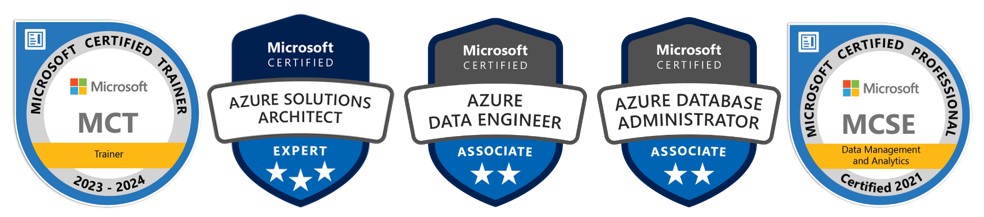
Microsoft recognizes Daniel’s expertise with the following certifications:- Microsoft Certified SQL Server DBA
- Microsoft Certified Azure Solutions Architect Expert
- Microsoft Certified Azure Data Engineer
- Microsoft Certified Trainer (MCT)
- MCSE in Data Management and Analytics
As a trainer, Daniel has mentored more than 3,000 students across the United States, Canada, and globally, helping professionals advance their careers in SQL Server, Azure, AWS, and AI. His teaching style blends real-world project experience with a structured, hands-on approach, making complex concepts easy to understand and immediately applicable.
Connect with Daniel at +1 267 718 1533 (Mobile & Whatsapp)
.Daniel's Technical Blog: https://empiredatasystems.com/blogs
Talk to Daniel
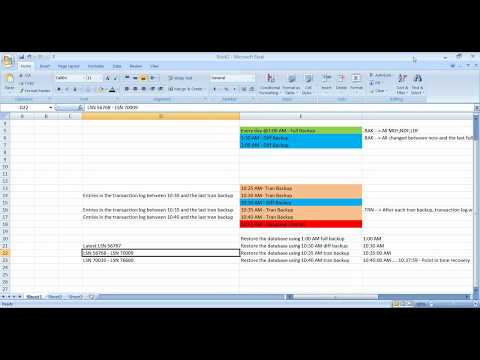
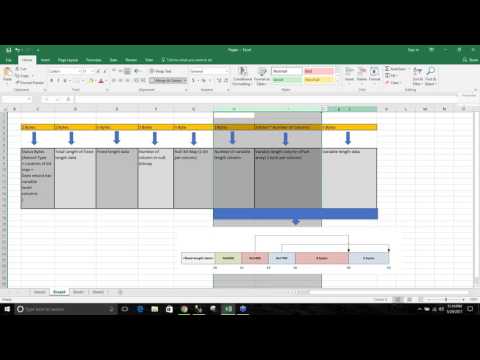
Live Training Videos
We believe in letting our prospective students to watch recorded videos of our live training classes and decide for themselves. If you would still like to attend a one-on-one live demo session, please give call Daniel @ 267 718 1533 and he can schedule one for you at your convenience.
Course Content
Part 1: SQL/TSQL Programming
RDBMS Concept
|
SQL Server Architecture
|
Creating schemas
|
Selecting appropriate data types
|
Adding constraints
|
Implementing various types of joins
|
Joining a table to itself
|
Combining queries with set operators
|
Scalar and Aggregate Functions
|
Summarizing data with aggregate functions
|
Grouping data
|
Extending group queries
|
Building crosstab reports
|
Declaring variables and parameters
|
Calling built-in scalar functions
|
Performing Extensive Analysis with Analytic Functions
|
RANK Function
|
Extending the use of aggregates
|
Building Sub-queries
|
Correlated sub-queries
|
Common table expressions (CTE)
|
PIVOT/UNPIVOT
|
Derived Tables
|
Maintaining Data
|
Transaction
|
SQL Server locking fundamentals
|
Programming procedural statements
|
Handling errors
|
Producing server-side result sets
|
Views
|
Functions
|
Triggers
|
Stored Procedures
|
Temporary Tables
|
Part 2: Database Administration
SQL Server Installation and Features
|
Storage Architecture & data redundancy
|
Essential tools
|
Creating and Managing Databases
|
Managing database space
|
Moving databases
|
Implementing Server and Database Security
|
Authorizing database access
|
Managing Permissions
|
Schemas
|
Catalog Information
|
Handling object-level permissions
|
Creating and managing indexes
|
Creating and managing Statistics
|
Transaction Log
|
System databases
|
Recovering from Disasters
|
Restoring databases
|
Export/Import data/database
|
Automating Tasks with Jobs and Alerts
|
Multistep jobs
|
Performing Database Maintenance
|
Ad hoc monitoring
|
Database Availably
|
SQL Server logs
|
Dead Locks
|
Latest Topics
|
Part 3: Performance Tuning
Executing queries
|
Performance tuning tools
|
Memory Management
|
L-L-W Issues
|
Lock Mode
|
Isolotion Level
|
Lock Granularity and Hierarchies
|
Analyzing performance using
|
Design effective SQL statements
|
Partitioning strategies for tables
|
Indexes tuning
|
Statistics Tuning
|
Part 4: Advanced DBA Topics
Advanced DBA Topics
|
Part 5: Azure SQL Infrastructure (Azure SQL + Managed Instance + Azure VM)
Azure SQL: Portfolio & setup
|
Azure SQL: Networking & access control
|
Azure SQL: Security deep dive
|
Azure SQL: Backup/restore & recovery
|
Azure SQL: HA/DR patterns
|
Azure SQL: Performance architecture & sizing
|
Azure SQL: Query performance & tuning
|
Azure SQL: Monitoring & automation
|
Azure SQL: Migration strategies
|
Azure SQL: DevOps & governance
|
Course Statistics
16
Years of Experience
3671
Gratified Students
112
Training Batches
9634
Training Hours
Gratified Student Feedback - From Year 2000
-
I have been very happy to attend this class . Though I was first time for computer class I got more than enough knowledge from Danial,he is really patient and knowledgeable with the course matter. He shared us also course materials as well as life time class videos. I don't hesitate to tell my friends !!!
Course: SQL Server DBA/TSQL
Trainer: Danial
Minyil
Mesa, United States -
Excellent training by Mr.Daniel!
Course: SQL Server DBA/TSQL
Trainer: Daniel
Darpina
Glen Allen, United States -
The training was interactive, comprehensive, perfect length and it was extremely good. Daniel had a dynamic approach , and he was very articulate in his presentations , and very prompt in answering all the questions .Overall I have thoroughly enjoyed all the sessions .I would recommend this DBA course to anyone who is seriously interested in learning....
Course: SQL Server DBA/TSQL
Trainer: Daniel
Roja K
Concord, United States -
It was great class with Mr Daniel.
Course: SQL Server DBA/TSQL
Trainer: Daniel
Asma Khanam
Hackettstown, United States -
For a beginner like myself, Daniels approach was very comforting. He was patient and dealt with the subject in detail. Thank you for providing such an excellent training Daniel.
Course: SQL Server DBA/TSQL
Trainer: Daniel AG
meghana arcot
Manchester, United States -
Good, like it.
Course: SQL Server DBA/TSQL
Trainer: Daniel AG
Hiwot
Columbus, United States -
Daniel...I really like the course and content. Thank you for your excellent teaching. I do appreciate all your help.
Course: SQL Server DBA/TSQL
Trainer: Daniel
Niteeka
Chicago, United States -
Daniel AG is the best teacher.
Course: SQL Server DBA/TSQL
Trainer: Daniel AG
Rediet Abebe
Alexandria, United States -
He is an awesome Trainer! I would definitely recommend him to any serous student who likes to pursue a career in Database. Thank you Daniel for your kind effort and clear explanations!
Course: SQL Server DBA/TSQL
Trainer: Daniel AG
Joinal Abedin
Arlington, United States -
The trainer is very professional and he definitely have a very deep knowledgeable about DBA. i would re command friends and family.
Course: SQL Server DBA/TSQL
Trainer: Daniel A G
Alemtsehay McClellan
Alexandria, United States -
Daniel AG is an excellent trainer. He has in-depth knowledge of the course materials.
Course: SQL Server DBA/TSQL
Trainer: Daniel AG
Jyoti Chalise
Leawood, United States -
It was awesome. I was taught exactly what I wanted to learn. The only thing I would say is if you could speak a little slowly. I was missing some things. I was not able to process it as quickly.
Course: SQL Server DBA/TSQL
Trainer: Daniel AG
Reena Patel
Redmond, United States -
I really Like this training Daniel makes life easier I enjoyed his class
Course: SQL Server DBA/TSQL
Trainer: Daniel AG
TSige
Washington, United States -
Daniel is one of the best trainer i have seen so far. He has always demonstrated patience and respectful guidance when interacting with students. He delivers content within the time frame allotted and is able to manage time efficiently even if faced with technical issues. He gave me insight to areas of my skills which i have never explored before. Hoping to see more and more support like this for us to find a job and apply the knowledge learnt in real world. Thank you very much Daniel! for delivering an excellent training.:)
Course: SQL Server DBA/TSQL
Trainer: Daniel A. G
Roopa
Shelton, United States -
Daniel's training was exceptional
Course: SQL Server DBA/TSQL
Trainer: daniel
kavitha beeram
Palmyra, United States -
He has a great knowledge and give real time examples He is very professional
Course: SQL Server DBA/TSQL
Trainer: Daniel
Mukund A Shah
Monmouth Junction, United States -
Excellent training,Learned a lot of SQL topics which I didn't know and more useful information for applying jobs.
Course: SQL Server DBA/TSQL
Trainer: Daniel
Thejaswi
Hoffman Estates, United States -
He is a very good Instructor. He communicates very well.
Course: SQL Server DBA/TSQL
Trainer: Daniel G
Shola Taiwo
Danville, United States -
One of the best training i attended.
Course: SQL Server DBA/TSQL
Trainer: Daniel
Ruchita
Grand Forks, United States -
Daniel is the best trainer for SQL DBA/Developer Training. He has deep knowledge, experiance and energy for beginners as well as experienced DBA/Developers. I am glad I had searched and find the best trainer online. Thankyou.
Course: SQL Server DBA/TSQL
Trainer: Daniel AG
Seble A.
Buena Park, United States -
Good class if you are dedicated to learn SQL.
Course: SQL Server DBA/TSQL
Trainer: Daniel AG
Sudish Shrestha
Fair Oaks, United States -
-The system of The Trainer 'how to teach' is best and easily understandable like face to face -The trainer more experence on DBA with respect to real work enviroment -every discussion on class are included on the video that means on some reason when you miss the class you can get the whole discussion on the video -Reasonable cost and perfect time -He is helpful for any quesition any time -Thanks Daniel, This trainning is best and I got more than my expectation.
Course: SQL Server DBA/TSQL
Trainer: Daniel AG
Adanech Jiru
Burlington, United States -
One of the best hands on training I have taken.
Course: SQL Server DBA/TSQL
Trainer: Daniel A G
Sreejesh Sasi
Brooklyn, United States -
I have not been regular due to work schedule but will be able to catch up with training videos. Great training as always. Thank You
Course: SQL Server DBA/TSQL
Trainer: Daniel
Assibong Kajih
Dallas, United States -
While I was researching on finding Institute to learn MsSQL Server in the vast sea of internet, a friend of mine who is also planning to learn the same course forwarded me Daniel Ag’s email. That email has Prerequisite reading material on RDBMS and when I contacted Mr. Daniel he sent me course-outline and a couple of videos from previous classes. Those three plus discussing with Mr. Daniel convinced me that I have found the right place I was looking for at a reasonable price. As per my expectations, Mr. Daniel’s method of teaching was full of discussions, lab exercises, a couple of research papers and abundant additional reading materials. He is punctual, very organized and very diligent to teach, answering all the questions that all the students throw at him in detail. In addition I have witnessed him helping students solving problems that are related to SQL Server they face at work. Thank you Mr. Daniel for making SQL server interesting and fun. Keep up the good work and hope we will meet again when I get back to take Business Intelligence course.
Course: SQL Server DBA/TSQL
Trainer: Daniel AG
Ketema Girma M.
United States, United States